
White House and FAA Announce Termination of FAA Emergency Order, Return to Normal Operations as of Tomorrow (Nov. 17) Morning
The full removal of the restrictions and resumption of normal operations across the National Airspace System (NAS) will take effect at 6am ET tomorrow (Nov. 17) morning.
(Washington, D.C.). U.S. Transportation Secretary Sean P. Duffy and Federal Aviation Administration (FAA) Administrator Bryan Bedford announced today (Nov. 16) that the agency’s flight reduction emergency order will be terminated tomorrow (Monday, November 17) at 6 a.m. ET, and that normal operations will resume across the National Airspace System (NAS).
Photo of the Federal Aviation Administration (FAA) seal courtesy of the FAA.
Per today’s press release from the FAA, the FAA safety team recommended the termination of the order following its reviews of safety trends and the steady decline of staffing-trigger events in air traffic control facilities.
In aviation, staffing-trigger events are defined as events that occur when the number of available air traffic controllers at a specific facility falls below a predetermined operational minimum.
“I want to thank the FAA’s dedicated safety team for keeping our skies secure during the longest government shutdown in our nation’s history and the country’s patience for putting safety first,” said Transportation Secretary Sean P. Duffy.
FAA Administrator Bryan Bedford commented: “Today’s decision to rescind the order reflects the steady decline in staffing concerns across the NAS and allows us to return to normal operations. I am grateful for the hard work of the FAA safety and operations teams and for their focus on the safety of the traveling public.”
The FAA’s termination order also ends restrictions that effectively prohibited general aviation operations at 12 of the 40 high-volume airports.
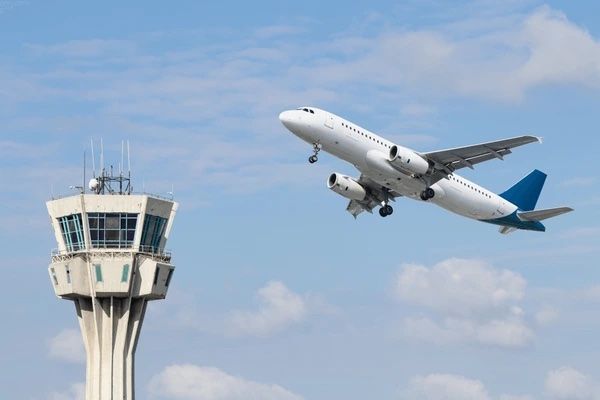
Image of an airliner flying next to an air traffic control tower courtesy of Shutterstock.
The removal of the restrictions for commercial and general aviation and the commercial space industry comes after the FAA announced on Friday, Nov. 14 that its required flight reductions at 40 airports would be lowered from 6 percent to 3 percent effective Nov. 15th; at that time, the FAA explained that the 3 percent reduction would remain in place while the FAA monitored system performance throughout the weekend and evaluated whether normal operations could resume, and the restrictions on general aviation operations at 12 airports remained in place.
This evening’s press release from the National Business Aviation Association (NBAA) applauds the removal of shutdown restrictions for general aviation and explains that the NBAA and other industry organizations are calling on Congress to approve a full-year appropriations bill for the Department of Transportation, including the FAA, to protect the agency from a potential government shutdown next year.
Additionally, as a long-term solution, aviation stakeholders are urging Congress to approve the Funding Stability Act of 2025, to allow the FAA to access the Airport and Airway Trust Fund to continue operating in the event of any future government closure, according to the NBAA.
“NBAA is pleased the shutdown restrictions have been lifted and that the entire general aviation industry, including business aviation, will be able to serve as a vital link in our nation’s transportation system, and a powerful engine for our economy,” said NBAA President and CEO Ed Bolen. “We are grateful to all who have worked to ensure the safety and efficiency of the nation’s aviation system under extraordinary circumstances.”
The following additional restrictions, which remained in place throughout this weekend, will be ended tomorrow:
- Some visual flight rule approaches (VFR) at facilities with staffing triggers.
- Commercial space launches and reentries permitted only between 10:00 p.m. and 6:00 a.m. local time.
- Parachute operations and photo missions near facilities with a staffing trigger.
The list ofthe 40 affected high-impact airports (whose restrictions will be ended tomorrow morning) includes:
ANC – Ted Stevens Anchorage International Airport
ATL – Hartsfield-Jackson Atlanta International Airport
BOS – Boston Logan International Airport
BWI – Baltimore/Washington International Airport
CLT – Charlotte Douglas International Airport
CVG – Cincinnati/Northern Kentucky International Airport
DAL – Dallas Love Field
DCA – Ronald Reagan Washington National Airport
DEN – Denver International Airport
DFW – Dallas/Fort Worth International Airport
DTW – Detroit Metropolitan Wayne County Airport
EWR – Newark Liberty International Airport
FLL – Fort Lauderdale/Hollywood International Airport
HNL – Honolulu International Airport
HOU – William P. Hobby Airport
IAD – Washington Dulles International Airport
IAH – George Bush Houston Intercontinental Airport
IND – Indianapolis International Airport
JFK – New York John F. Kennedy International Airport
LAS – Las Vegas McCarran International Airport
LAX – Los Angeles International Airport
LGA – New York LaGuardia Airport
MCO – Orlando International Airport
MDW – Chicago Midway International Airport
MEM – Memphis International Airport
MIA – Miami International Airport
MSP – Minneapolis–St. Paul International Airport
OAK – Oakland International Airport
ONT – Ontario International Airport
ORD – Chicago O’Hare International Airport
PDX – Portland International Airport
PHL – Philadelphia International Airport
PHX – Phoenix Sky Harbor International Airport
SAN – San Diego International Airport
SDF – Louisville International Airport
SEA – Seattle–Tacoma International Airport
SFO – San Francisco International Airport
SLC – Salt Lake City International Airport
TEB – Teterboro Airport
TPA – Tampa International Airport


