
Whisper Aero Announces First Piloted Flight Using UltraQuiet™ Electric Propulsion System
Whisper’s eQ250 electric ducted fans flew aboard the Whisper Powered Swift glider aircraft.
(Crossville, Tennessee) Propulsion solution developer Whisper Aero announced today (Aug. 19) that it has successfully completed the first piloted flights using its eQ250 electric propulsors, which were flown aboard the Whisper Powered Swift glider aircraft at the company’s flight-test center at Crossville Memorial Airport.
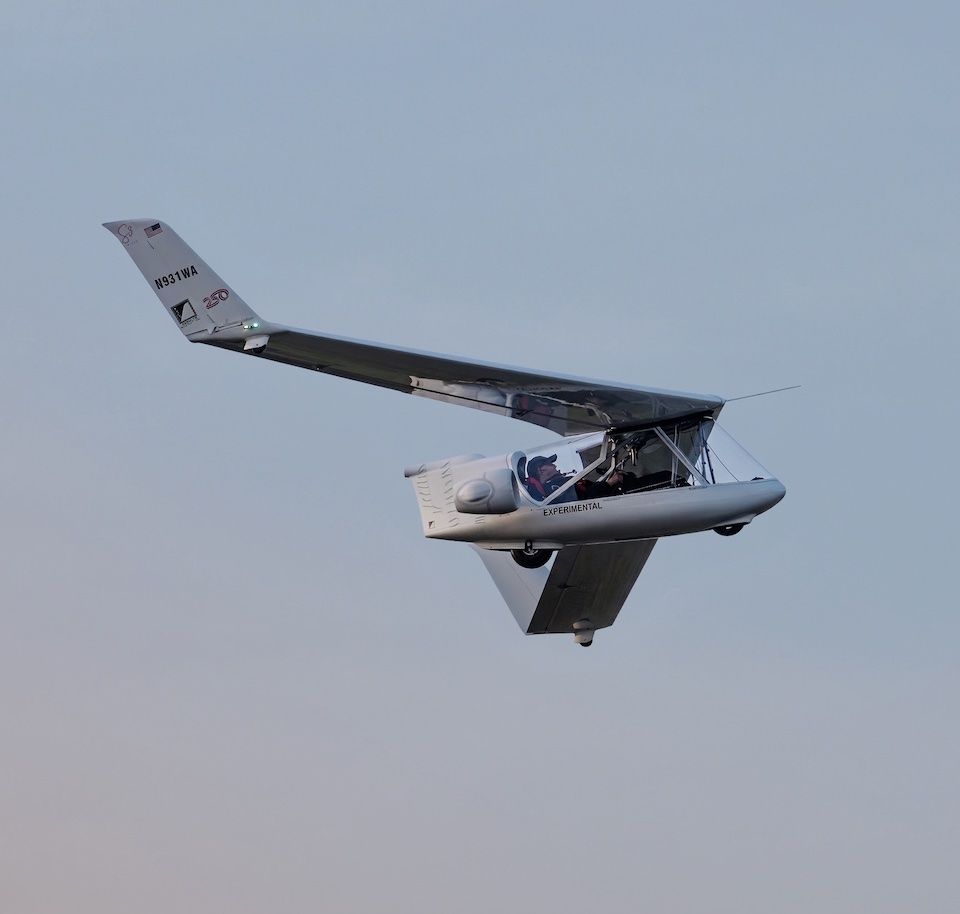
Image of Whisper Aero’s Whisper Powered Swift glider – featuring the company’s eQ250 electric propulsors – in flight, courtesy of Whisper Aero.
Per today’s press release from Whisper, the flights mark and important transition from ground-based validation to piloted flight testing of its electric propulsion system, and establish a foundation for larger civil and defense aircraft applications.
“All of our propulsion systems are dual-use by design, so there are defense customers interested in the eQ250, and, as we continue to build up the base of users and validation test data in the sky, that becomes helpful foundational work that accelerates work on civil flights,” explained Whisper Aero COO & Chief Product Officer Ian Villa.
The Whisper Powered Swift aircraft completed its planned objectives across three flights, which totaled more than 130 minutes in the air. The flights followed a phased test campaign that included progressively ballasted glider flights, aircraft integration testing, formal readiness reviews, and 1,000 hours of propulsion life testing, according to Whisper.

Image of Whisper Aero’s Whisper Powered Swift glider – featuring the company’s eQ250 electric propulsors – courtesy of Whisper Aero.
As for noise-related specs asociated with the eQ250 proulsion system:
- Whisper’s propulsion at full throttle proved quieter than the 46’ wingspan aircraft, even when flying at a 100’ altitude;
- early morning flights with a 34 dB(A) ambient showed only 52 dB(A) coming from the aircraft.
Per Whisper, the ability to fly within the soundscapes of even rural environments with Whisper propulsion will be critical for flights of FAA MOSAIC aircraft capable of flying anywhere, any time.
“The eQ250 propulsion system is really flexible,” Villa said. “That’s one of thee beautiful things about that propulsion unit – by design we made it really great for groups of three, four or five drones. We are thinking about this in the context of the FAA’s MOAIC (Modernization of Special Airworthiness Certification) rule and Part 23 and Part 21.17b – which dictate rules for two-passenger personal aircraft and up to nine-passenger regional jets. Having this propulsion system up in the air – especially given all the momentum around FAA MOSAIC – gives us data and shows us that we have the quality and manufacturing muscle we need in-house; it also shows us where we need to build up our systems to get to the scale we’d like.”
Whisper’s first electric flights in Tennessee were supported by Tennessee Tech University via a $500,000 Transportation Network Growth Opportunity (TNGO) award from the Tennessee Department of Economic and Community Development (TNECD); Tennessee Tech faculty and students supported ground testing and the integration of the aircraft’s propulsors, batteries, and controllers alongside additional engineers from Whisper Aero and Flighthouse Engineering.


