
To the Moon, Mars & Beyond: What’s Next For SpaceX’s Starship?
Yesterday’s successful Starship Flight Test Five marked the completion of yet another step toward Elon Musk’s goals of fulfilling NASA’s Artemis III mission and sending the first Starship to Mars in 2026.
(Boca Chica, Texas) The world watched as SpaceX successfully launched its fifth test flight of Starship – the most powerful rocket system ever constructed which bears the ultimate goal of carrying humans to the moon and Mars – yesterday (Oct. 13) morning, demonstrating how SpaceX plans to ultimately recover and refly Super Heavy boosters and Starship spacecraft in non-test, commercial flights.
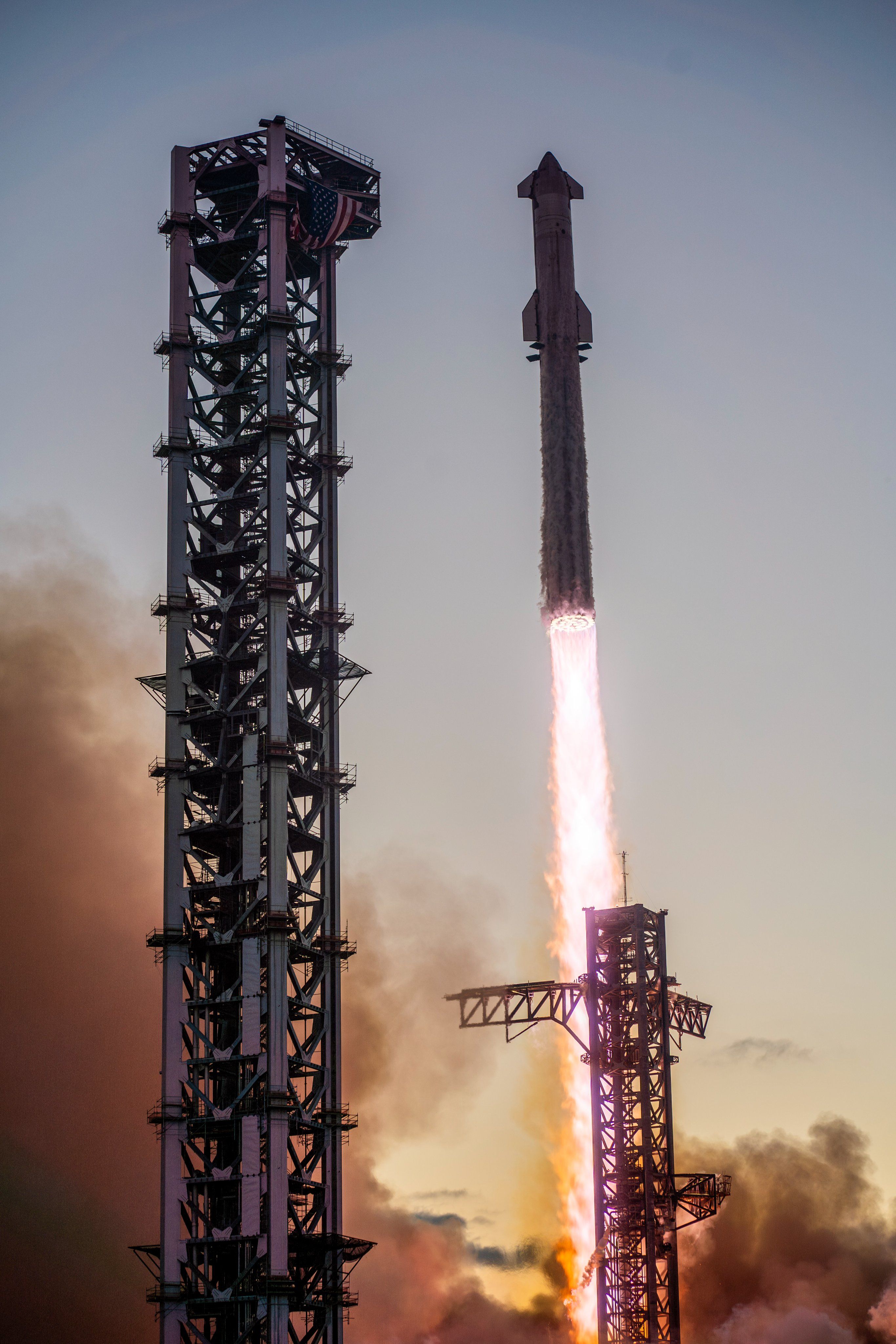
Photo of SpaceX’s Starship spacecraft launching from its “Mechazilla” launch tower in Boca Chica, Texas courtesy of @spacex on X.
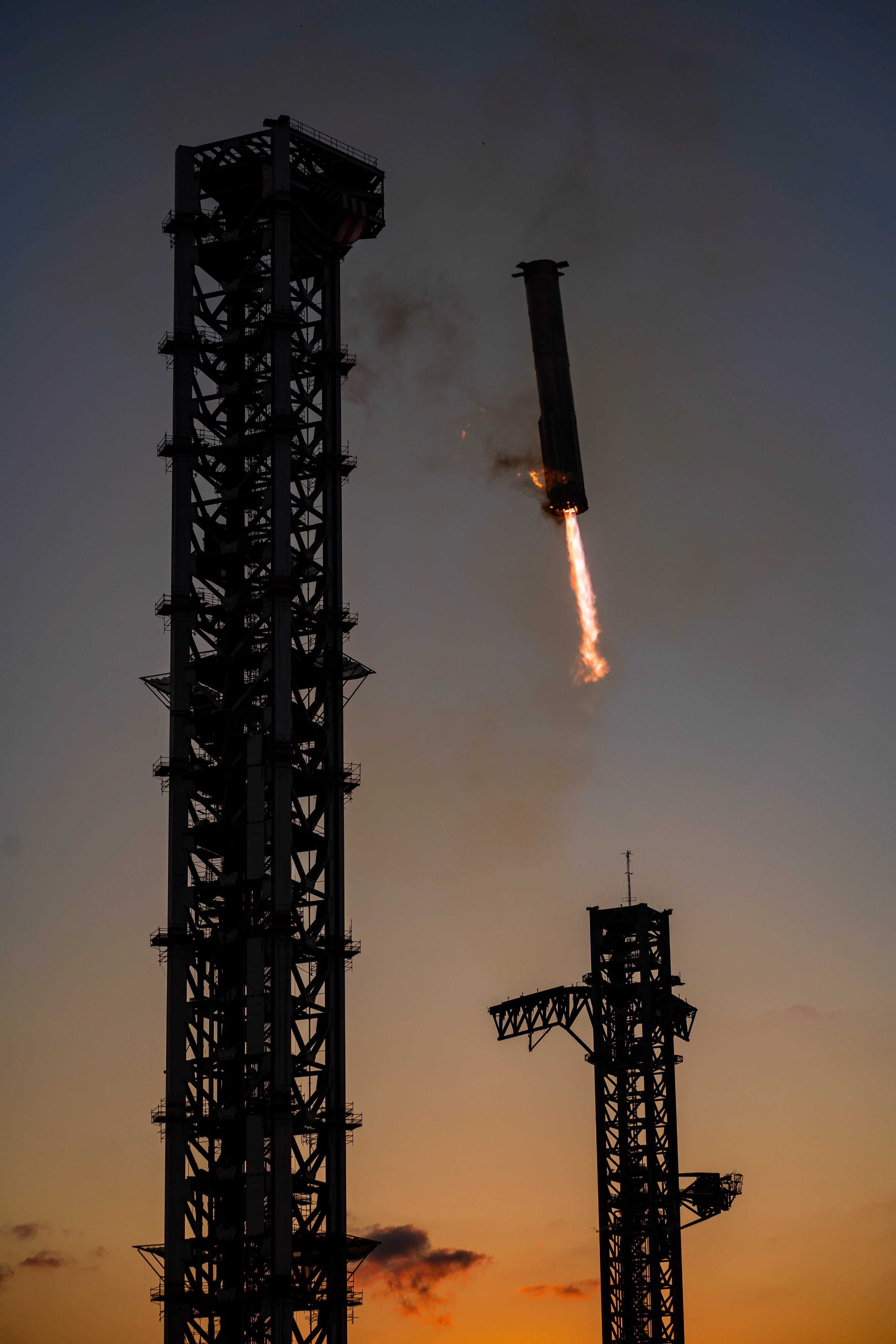
Photo of SpaceX’s Starship Super Heavy booster returning to its “Mechazilla” launch tower courtesy of @spacex on X.
For those who (for whatever strange reason) missed yesterday’s historical feat, SpaceX’s Starship behemoth not only launched; for the first time, its 232-foot Super Heavy booster returned to its launch site and was essentially “snatched” out of the air by the massive mechanized metal arms of its “Mechazilla” launch tower (the same tower where the rocket launched just minutes prior).
SpaceX’s capability of catching its Starship booster on its return to Earth is critical to the company’s future goals, providing a completely reusable vehicle that is able to fly again.
Going forward, beyond its forthcoming test flights, SpaceX plans to use Starship as the landing vehicle that will ferry NASA astronauts to the moon as soon as 2026 as part of the Artemis III mission, and for a future mission to transport the first human to Mars.
As for its Artemis III goal (for background, Artemis, NASA’s flagship human spaceflight program, aims to transport astronauts to the surface of the moon for the first time since the Apollo program more than 50 years ago), SpaceX currently maintains government contracts worth up to nearly $4 billion to complete the task, according to CNN.
SpaceX’s nearly 400-foot tall Starship spacecraft and Super Heavy rocket – collectively referred to as Starship – comprise a fully reusable transportation system designed to carry both crew and cargo to Earth orbit, the Moon, Mars and beyond. Some additional Starship specs:
Height: 397 feet (121 meters)
Diameter: 29.5 feet (9 meters)
Payload capacity: 100 – 150 metric tonnes (fully reusable)
Rocket reusability has been critical to making space flight affordable in the 21st century, with SpaceX leading the way in affordability initiatives. The cost of launching a spacecraft today is about 10x cheaper than it was a decade ago.
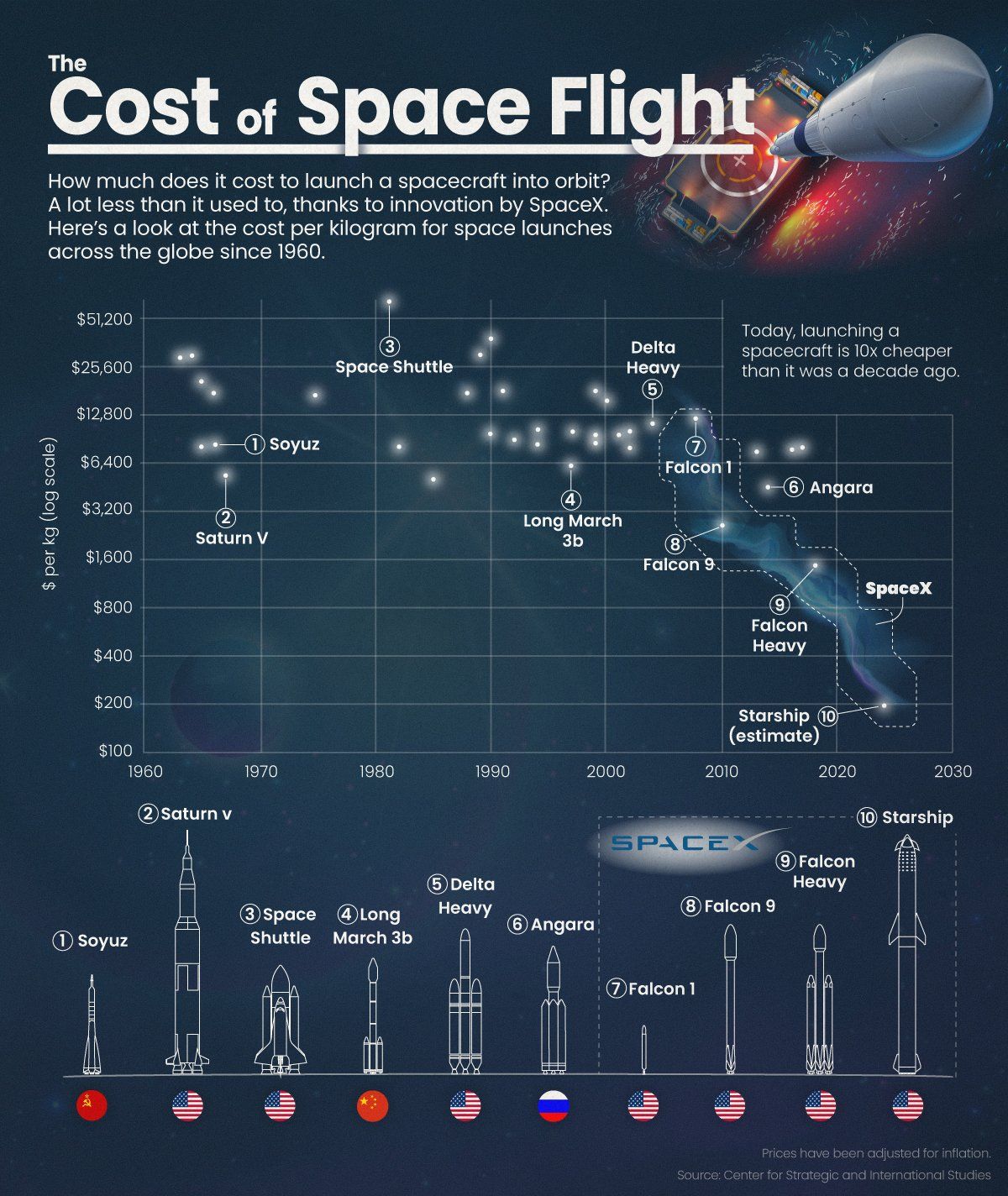
Graph depicting the decreasing cost of spaceflight from the Center For Strategic and International Studies courtesy of @cremieuxrecueil on X.
Per SpaceX, Starship is the world’s most powerful launch vehicle ever developed, and is capable of carrying up to 150 metric tonnes of cargo in its fully reusable state, and up to 250 metric tonnes expendable. In addition to helping to enable satellite delivery, the development of a Moon base and point-to-point transportation on Earth, SpaceX’s plan for the Starship rocket system is to ultimately be able to carry up to 100 people on long-duration, interplanetary flights.
Starship’s on-orbit refiling mechanism will involve using large tanker vehicles – which are essentially windowless Starship spacecraft – to refill Starship spacecraft in low-Earth orbit prior to departing for Mars, ultimately enabling the transport of up to 100 tons to Mars, according to SpaceX.
Starship’s development, which takes place at Starbase – one of the world’s first commercial spaceports designed for orbital missions and one of four active launch states in the United States operated by SpaceX – in Boca Chica, Texas, began in 2019 and has thus far centered around a series of test flights. The inaugural test launch of a Starship and Super Heavy – dubbed an integrated test flight – took place in April 2023, and resulted in getting the vehicle off of its launchpad – a feat which ended minutes later with an explosion over the Gulf of Mexico.
Starship’s fourth test flight, which took place in June, survived reentry into Earth’s atmosphere and practiced touchdown maneuvers over the ocean, despite both the booster and spacecraft suffering significant damage.
Details and timing related to SpaceX’s forthcoming Starship Flight Test 6 have not yet been confirmed.


