
Voyager Technologies Announces Strategic Investment in Max Space to Advance Development of Expandable Space Habitats
Max Space’s expandable space habitats are intended to support sustained lunar operations and future deep-space missions.
(Denver, Colorado) Voyager Technologies (NYSE: VOYG) announced this morning (Mar. 9) a multi-million dollar strategic investment in Max Space to advance the development of what the company dubs as next-generation expandable space habitats supporting sustained lunar operations and future deep-space missions.
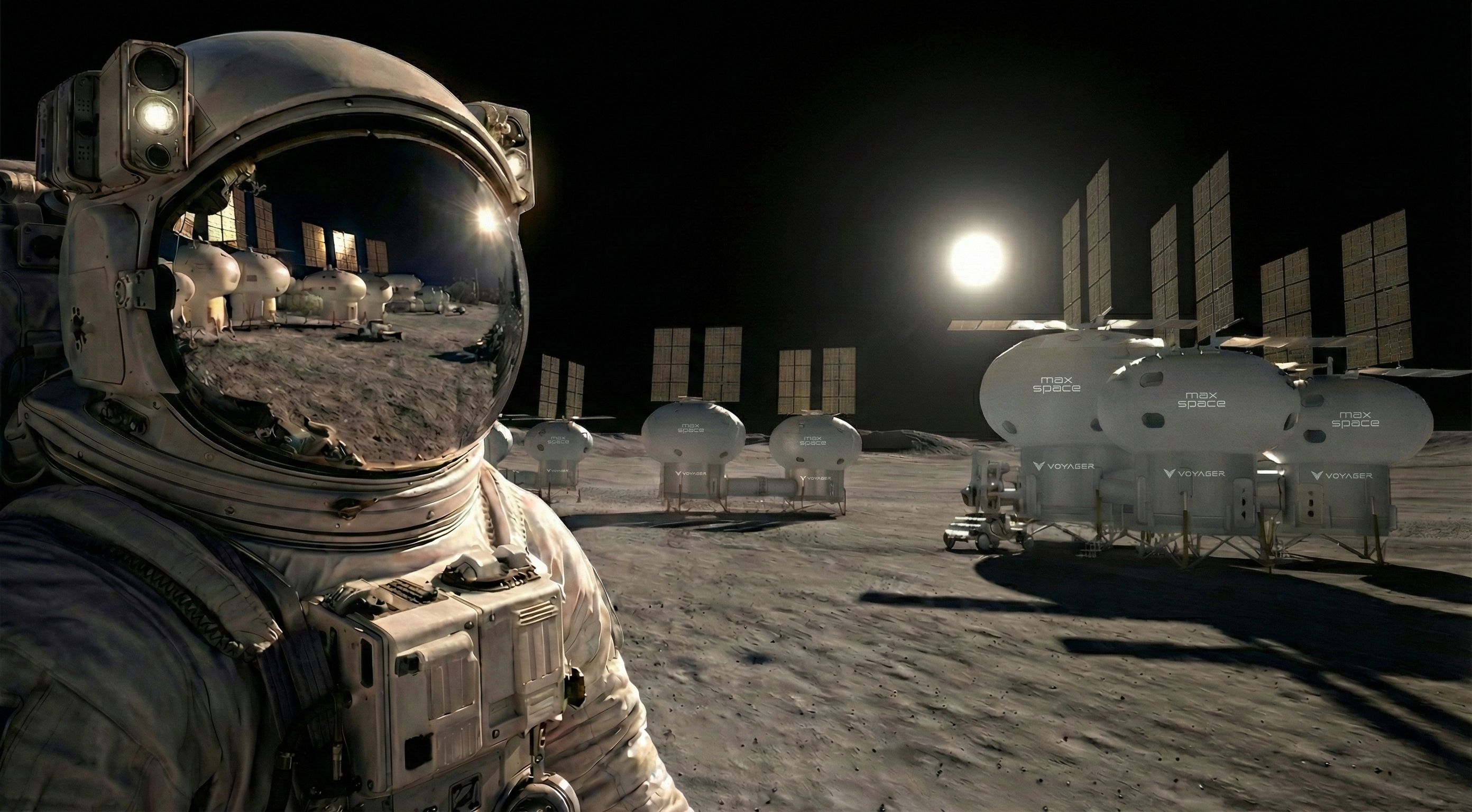
Rendering courtesy of Voyager Technologies.
Voyager will also support internal research and development efforts to accelerate engineering, manufacturing scale-up and mission integration activities, according to this morning’s press release from the company.
“Expanding human presence beyond low-Earth orbit requires infrastructure that is scalable, resilient, and purpose-built for permanence,” said Dylan Taylor, chairman and CEO of Voyager. “Our investment in Max Space aligns directly with our strategy to deliver mission-ready systems that extend American strength into cislunar space. By pairing Voyager’s integrated platform with Max Space’s expandable habitat architecture, we are accelerating the transition from demonstration missions to durable lunar capability.”
The expandable habitat initiative supports NASA’s historical Artemis Program and aligns with Administrator Jared Isaacman’s announcement to be on the Moon to stay by 2028, as Max Space delivers critical enabling infrastructure, maximizes livable volume, enhances crew safety and reduces costs and complexity of surface deployment – thereby complementing Voyager’s broader lunar roadmap, and reinforcing a shared vision of the Moon as an operational domain – rather than a temporary destination – according to Voyager.
Per Voyager, Max Space’s expandable habitat technology launches compactly and expands up to 20 times its stowed volume at its destination; the architecture enables significantly more usable floor area per kilogram delivered, optimizing human productivity and operational flexibility in a gravity environment.
Flexible geometries associated with Max Space’s expandable habitat tech enable optimization for evolving mission needs, from early surface missions to long-duration lunar habitation, according to Voyager.
“Max Space was built to solve the hardest problem in lunar exploration: delivering safe, scalable, and permanent human space at an economically viable mass,” said Saleem Miyan, co-founder and CEO of Max Space. “Voyager’s investment is a powerful validation of our expandable habitat thesis and long heritage in orbit. Together we are building habitats designed not just to reach the moon but to stay there.”


