
The Past 24 Hours Saw SpaceX Launch Starlink (8/12) and ABSM (8/11) Missions
SpaceX launched 23 Starlink satellites to LEO this morning after sending Space Norway’s Arctic Satellite Broadband Mission (ABSM) to Molniya transfer orbit yesterday (Aug. 11) afternoon.
(Cape Canaveral, Florida & Lompoc, California) The past 24 hours saw Elon Musk’s SpaceX launch 23 Starlink satellites to low-Earth orbit (LEO) from Cape Canaveral, Florida (this morning, Aug. 12, at 6.37 a.m. ET (10.37 GMT)) and the Space Norway Arctic Satellite Broadband Mission (ASBM) to Molniya transfer orbit from Vandenberg Space Force Base in California (Sunday, Aug. 11 at 7.02 p.m. PT (2.02 GMT)).
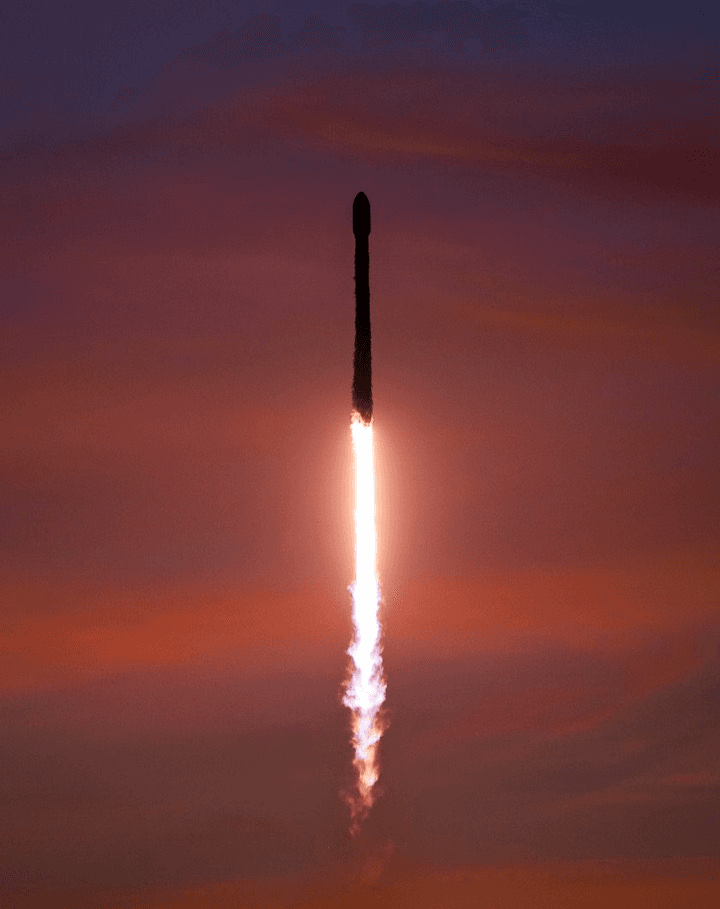
Photo of this morning’s (August 12th) SpaceX launch of 23 Starlink satellites to low Earth orbit (LEO) courtesy of SpaceX on Instagram, @spacex.
This morning’s launch of 23 Starlink satellites to LEO marked the 17th flight for the first stage Falcon 9 booster supporting the mission, which previously launched SES-22, ispace’s HAKUTO-R MISSION 1, Amazonas-6, CRS-27, Bandwagon-1, and now 12 Starlink missions, per SpaceX.
Sunday’s launch of the ASBM mission marked the 22nd flight of the first stage booster supporting the mission, which previously launched Crew-1, Crew-2, SXM-8, CRS-23, IXPE, Transporter-4, Transporter-5, Globalstar FM15, ISI EROS C-3, Korea 425, Maxar 1, and 10 Starlink missions, according to SpaceX.
The 22nd flight of the ABSM missions’ Falcon 9 rocket tied SpaceX’s rocket-reuse record, which was set this past June during a launch of SpaceX’s Starlink internet satellites, according to Space.com. Falcon 9 deployed the first ASBM satellite into orbit 42.5 minutes after liftoff and the second five minutes later, per Space.com.
The two satellites launched for the Arctic broadband mission each carried multiple payloads, including the U.S. military’s Enhanced Polar System-Recapitalization (EPS-R), according to SpaceNews.
Space Norway is a state-owned enterprise that manages and develops strategic space infrastructure – specifically, the company is 100% owned by the by the Norwegian Ministry of Trade, Industry and Fisheries and represents a key part of the Norwegian Government’s activities and assets in the space sector. The company provides satellite communication services and infrastructure for government, defense and commercial industries.
The Northrop Grumman (NYSE: NOC) -built ASBM satellites are designed to expand broadband coverage to the Arctic region for the U.S. Space Force and Space Norway, providing broadband communications services over the North Pole and high-latitude areas, per Northrop Grumman.
The ASBM satellites also included military payloads for the U.S. and Norwegian Armed Forces, a commercial payload for Viasat and a radiation monitor for the European Commission; per Northrop Grumman, the ASBM mission marked the first time an operational DoD payload (EPS-R) was hosted on an international space vehicle.


