The Federal Aviation Administration (FAA) Announced Nearly $300 Million in Sustainable Aviation Fuels and Tech Awards on Friday (Aug. 16)
The funding, which is part of the Biden-Harris administration’s Investing in America agenda, will support progress in decarbonizing the aviation industry.
(Washington, D.C.) This past Friday (Aug. 16), the Federal Aviation Administration (FAA) announced $291 million in grants aimed at advancing sustainable aviation fuels (SAF) and low-emission aviation technologies as part of the Biden-Harris administration’s Investing in America agenda.

Photo courtesy of The Federal Aviation Administration (FAA).
The funding, which is part of the U.S. Department of the Treasury’s Inflation Reduction Act, supports the administration’s goal of net-zero greenhouse gas emissions from the aviation industry by 2050.
Per the Federal Aviation Administration (FAA)’s August 16th press release, U.S. Secretary of Transportation Pete Buttigieg said, “The Biden-Harris Administration is committed to enhancing the safety, sustainability and efficiency of our national air transportation system—and reaching our mid-century target of net-zero emissions. These grants will help put the world on a path toward decarbonizing aviation while fostering domestic economic growth and ensuring the U.S. retains its global leadership in aviation.”
The U.S. Federal Government is increasingly focused on supporting the aviation industry’s transition to sustainable aviation fuel (SAF) as part of a larger effort to reduce greenhouse gas emissions and combat climate change. SAF, made from renewable sources like waste oils and agricultural residues, can significantly cut carbon emissions compared to those associated with conventional jet fuel, and comprises a significant part of the aviation industry’s efforts to meet global climate goals, including as achieving net-zero emissions by 2050, as outlined in President Biden’s Executive Order 14057 and often referred to as “The Federal Sustainability Plan.”
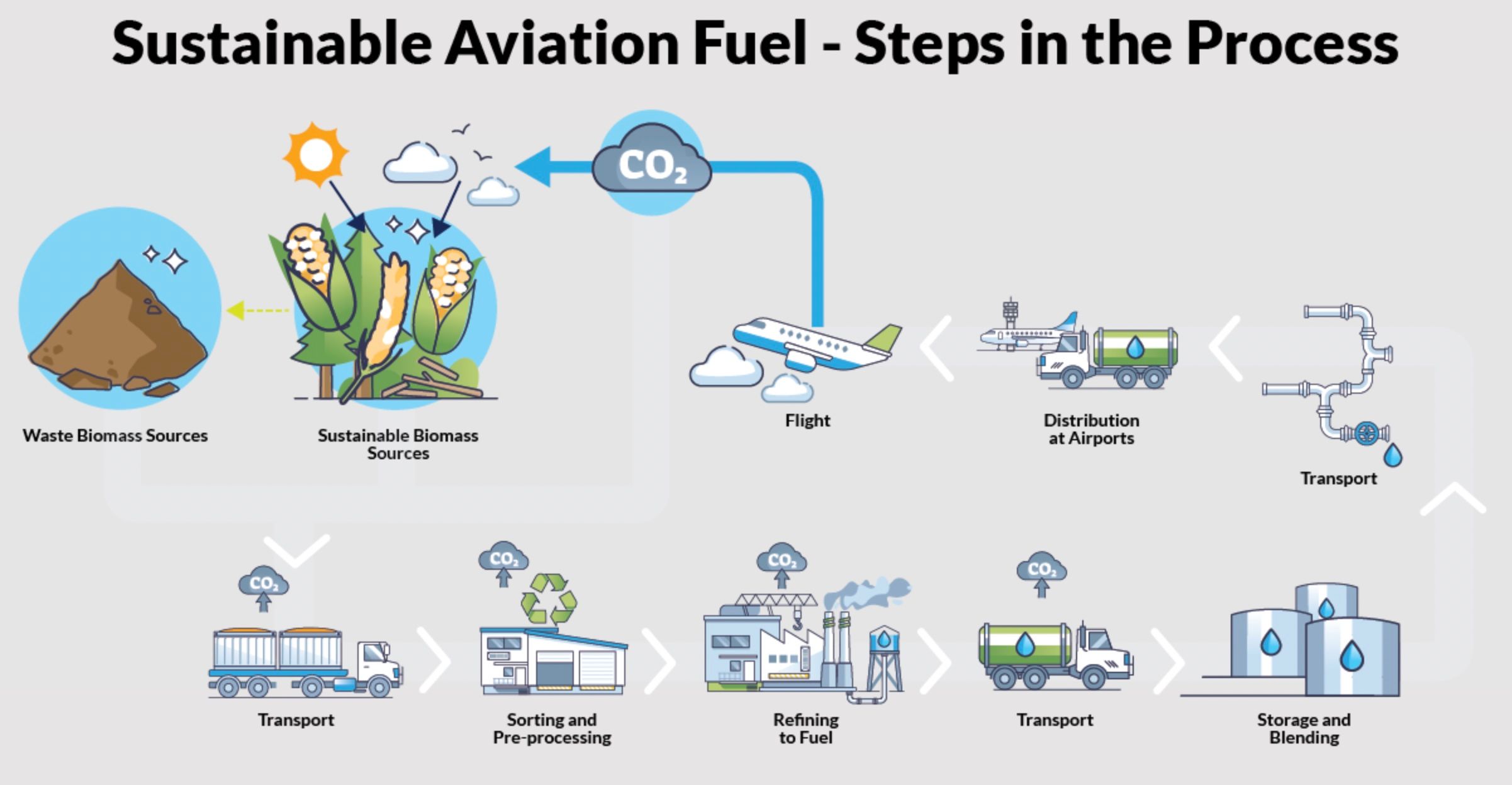
Diagram of ‘Sustainable Aviation Fuel – Steps in the Process’ from the Federal Aviation Administration’s (FAA) Fueling Aviation’s Sustainable Transition (FAST) Grants page.
“These grants are crucial for reducing carbon pollution and boosting the U.S. aviation sector’s sustainability,” said FAA Assistant Administrator Laurence Wildgoose in Friday’s FAA press release. “The projects span 23 states and involve a range of stakeholders, including fuel producers, universities, and local governments.”
The FAA will distribute the grants through the Fueling Aviation’s Sustainable Transition (FAST) program. The FAST grants include:
- $244.5 million to support 22 projects focused on producing, transporting, and storing SAF, and for scoping studies related to SAF infrastructure needs, and
- $46.5 million will fund 14 projects that develop, demonstrate or apply low-emission aviation technologies.
Key projects supported by the FAST awards include:
- Gevo, Inc. in Minnesota will receive $16.8 million to convert a fuel facility for SAF production.
- The City of Atlanta will receive $240,000 to study SAF deployment at Hartsfield-Jackson Airport.
- JetZero, Inc. will receive $8 million to develop its fuel-efficient blended-wing-body airplane.
- The University of Illinois in Urbana-Champaign will receive $2.7 million to build a test facility to mature high-power electrified airplane technologies.
World Energy, a manufacturer of SAF, renewable diesel, and renewable naphtha (a flammable liquid hydrocarbon mixture), with plans to create renewable propane and green hydrogen, shared on its Instagram page today (@officialworldenergy): “World Energy is honored to be among the recipients of the FAA’s $291 million grant program, announced on the two-year anniversary of the Inflation Reduction Act. The program is a necessary step in driving SAF distribution infrastructure to be installed in the least carbon intense (CI) way. The most effective means of decarbonizing aviation begins with producing the lowest possible CI SAF.”

Timeline of U.S. Annual Sustainable Aviation Fuel Procurements courtesy of The Federal Aviation Administration (FAA)’s Sustainable Aviation Fuels (SAF) webpage.
Support for SAF continues to grow in D.C. as members of both sides of the aisle in Congress work together to ensure a safe and seamless transition to SAF. Just last week (Aug. 11), U.S. Congressmen Mike Flood (R-NE) and Troy A. Carter, Sr. (D-LA) put forward the Sustainable Aviation Fuel (SAF) Information Act, which seeks to mandate the U.S. Energy Information Administration (EIA) to explicitly incorporate SAF data into its weekly and monthly reports, aligning it with the reporting practices for other fuel types.