
SpaceX Launches the First Two U.S. Rockets of 2024 on Jan 2 and Jan 3
A Falcon 9 rocket launched from Florida carrying the Ovzon 3 mission this evening, subsequent to another Falcon 9 launching 21 Starlink satellites to LEO last night, on January 2nd.
(Cape Canaveral Space Force Station, Florida & Vandenberg Space Force Base, California) Elon Musk’s SpaceX has completed the United States’ first two rocket launches of 2024, with its Ovzon 3 mission earlier tonight from Cape Canaveral Space Force Station in Florida following last night’s (January 2nd) Starlink mission from the Vandenberg Space Force Base in California.
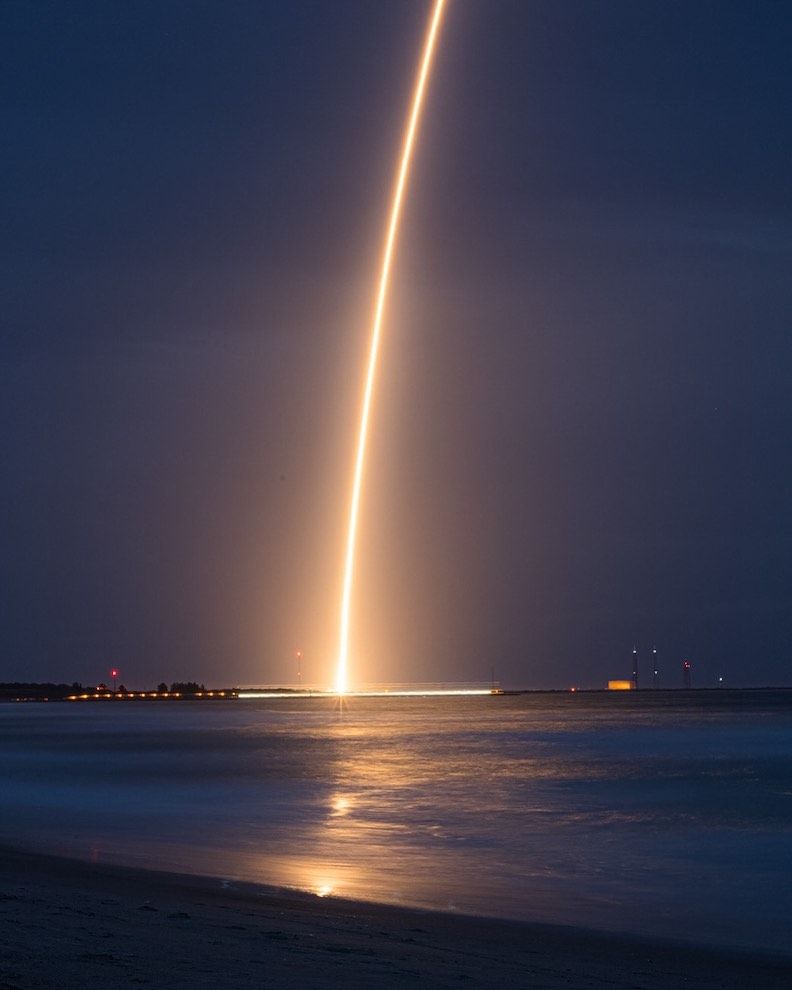
Photo of SpaceX’s Falcon 9 returning to Cape Canaveral from its Ovzon 3 launch tonight courtesy of John Krauss on Instagram.
The launches are the second and third of 2024 globally, after India’s Indian Space Research Organization (ISRO) launched the first rocket of 2024 on January 1.
Earlier this evening (January 3rd), a Falcon 9 rocket carrying the Ovzon 3 communications satellite lifted off from Cape Canaveral Space Force Station at 6.04pm EST. The Falcon 9’s first stage returned to Earth as planned, touching down back at Cape Canaveral about eight minutes after liftoff and marketing the 10th launch and landing for this particular booster, according to Space.com.
The Ovzon 3 satellite is the first privately funded and developed Swedish geostationary satellite, and will allegedly cover one-third of the earth via its steerable spot beams in order to meet demand for better mobile broadband coverage in under-served regions, according to Everyday Astronaut.
As for last night’s launch: on Tuesday, January 2nd at 7:44pm PST (10:44pm EST), a Falcon 9 launched 21 Starlink satellites to low-Earth orbit from Space Launch Complex 4 East (SLC-4E) at Vandenberg Space Force Base in California. This was the first flight for the first stage booster supporting this mission, according to SpaceX.
The Starlink launch included the first six Starlink satellites with direct-to-cellphone capabilities, which, according to SpaceX “enable mobile network operators around the world to provide seamless global access to texting, calling, and browsing wherever you may be on land, lakes, or coastal waters without changing hardware or firmware.”
SpaceX’s website explains that “the enhanced Starlink satellites have an advanced modem that acts as a cellphone tower in space, eliminating deadzones with network integration similar to a standard roaming partner.”
Cellular providers using Starlink’s Direct to Cell service to gain “reciprocal access in all partner nations” include: T-Mobile in the U.S., Rogers in Canada, KDDI in Japan, Optus in Australia, One NZ in New Zealand, Salt in Switzerland, and Entel in Chile and Peru, according to SpaceX,
During an August 2022 event featuring SpaceX founder Elon Musk and T-Mobile CEO and President Mike Sievert, Musk called the new addition “a massive game changer” that would help eliminated dead zones across the globe, according to SpaceFlight Now.
“This really is a big deal,” Musk said during the presentation. “Even if an entire region or country lost connectivity because of a severe hurricane or floods or fires or tornados, earthquakes… even if all the cell towers were taken out, your phone would still work.”
As per a Nov. 30, 2023 email from Jameson Dempsey, SpaceX’s director of satellite policy, to Kathyrn Medley, the acting division chief of the Federal Communication’s (FCC) Satellite Licensing Division, SpaceX anticipates launching “approximately 840 direct-to-cell capable satellites over the next 6 months, with additional launches continuing after that period.”


