SpaceX Launches Starship Flight 14, its First Orbital Mission
The flight - which launched at 7.45am CT (8.46am EDT) from SpaceX’s Starbase in Boca Chica, Texas - will be the first to send Starship into orbit around Earth.
(Starbase, Tecas) SpaceX (NASDAQ: SPCX) successfully launched its Starship Flight 14 from Starbase in Boca Chica, Texas at 7.45am this morning (Sept. 28) — marking the first-ever orbital mission of SpaceX’s Starship rocket.
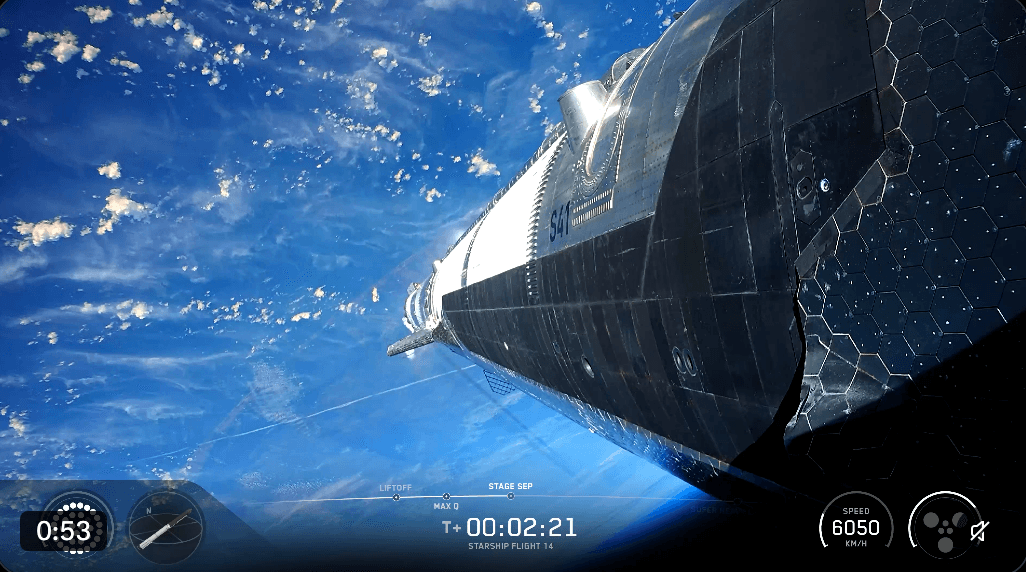
Image of Starship’s Raptor engines ignite during hot-staging separation during this morning’s (Sept. 28) Flight 14 courtesy of SpaceX via X, @spacex.
Plainly speaking, the flight will be the first to send Starship into orbit around Earth; up until now, Starship flight tests have intentionally flown passively safe suborbital trajectories to maximize public safety while allowing for learning, per SpaceX’s mission description.
During today’s test flight, Starship is expected to complete six full laps of Earth over about 10 hours.
As explained by SpaceX, by going to orbit, the next phase of developing Starship to be fully and rapidly reusable can begin.
After the flight reached orbit post-9am this morning, SpaceX began deploying its batch of 26 Starlink V3 satellites. Per CNNScience, the satellites are the first belonging to a new generation of capacity- and reliability-boosting Starlink satellites, as SpaceX continues to build out its high-speed global internet business.
Specifically, each Starlink V3 satellite will add 1 Tbps of capacity to the constellation, for a total of 26 Tbps of capacity added on this Flight 14 mission alone; that’s ~10x the capacity compared to a single launch of V2 mini Starlink satellites on Falcon 9.
Per SpaceX, the primary booster objectives of Starship 14 involve the execution of a successful launch, ascent, stage separation, boostback burn, and landing burn at an offshore landing point in the Gulf of America, after modifications to hardware and software were made to address issues incurred on Starship’s previous Flight 13.