
NASA Awarded a Total Additional $100 Million to Blue Origin and Voyager Space for Commercial Space Station Concepts on Jan. 5
With the ISS set for retirement in 2030, NASA has Space Act Agreements with Blue Origin and Voyager Space to develop concepts for a new orbiting lab.
(Washington, D.C.) On January 5, 2023 NASA announced that it had modified agreements with an additional $100 million in total funding for two funded commercial space station partners – Blue Origin and Voyager Space – that are in the process of developing low Earth orbit (LEO) destinations for NASA and other customers as the International Space Station (ISS) retires in 2030.
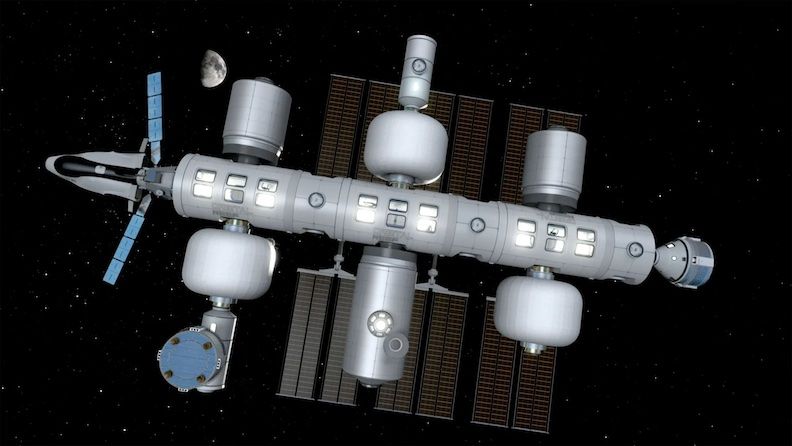
Rendering of a top view of Blue Origin’s Orbial Reef station via the Orbital Reef team, c/o NASA.
The changes add new technical milestones and reallocate existing funding to allow NASA to accelerate efforts as part of its goal to foster a commercial LEO economy, according to NASA’s announcement.
Blue Origin will receive an additional $42 million for its Orbital Reef station, bringing its total award to $172 million, and Voyager Space’s Exploration Segment, which includes Nanorocks, will receive an additional $57.5 million for its Starlab station, bringing the total award to $217.5 million.
The additional funding comes as Northrop Grumman (NYSE: NOC) and Starlab have joined as partners – Northrop and Starlab were previously working under separate Space Act Agreements. NASA transferred funding freed up from the withdrawal of Northrop Grumman from its agreement with NASA, as well as other program funding, to add new milestones to the existing agreements with Blue Origin and Starlab.
New milestones for Blue Origin’s Orbital Reef station include several additional subsystem design reviews and technology maturation activities, as well as tests and demonstrations in the environmental control and life support system, such as water filtration and atmospheric monitoring.
New milestones for Voyager Space’s Starlab station include the addition of Development milestones for Northrop Grumman Cygnus spacecraft – upgrading from berthing to docking to better serve Starlab and commercial markets – as well as additional Starlab development milestones focused on operations, assembly, integration and testing as well as a rendezvous and proximity operations demonstration.
While Blue Origin and Voyager Space/Nanoracks have
Space Act Agreements with NASA – created in December of 2021 -NASA’s other funded commercial station partner, Axiom Space, holds a firm-fixed price contract with the agency. NASA is in the process of negotiating additional content to Axiom Space’s contract; details are being finalized and more information will be released by the agency as those negotiations are completed, according to NASA.
NASA is supporting the design and development of multiple commercial space stations with the three funded partners listed above, as well as several other partners with unfunded agreements through NASA’s Collaborations for Commercial Space Capabilities-2 project.
“We continue to see an immense amount of dedication from our partners,” said Angela Hart, manager of Commercial Low Earth Orbit Development Program at NASA’s Johnson Space Center in Houston, in NASA’s January . “The agency is committed to continuing to work with industry with the goal having one or more stations in orbit to ensure competition, lower costs, and meet the demand of NASA and other customers.”
NASA’s commercial strategy for low Earth orbit will provide the government with reliable and safe services at a lower cost and enable the agency to focus on Artemis missions to the Moon in preparation for Mars, while also continuing to use low Earth orbit as a training and proving ground for those deep space missions, according to NASA.


