
NASA Announces Partnership with Eric Schmidt’s Relativity Space for Mars Mission
Relativity Space has been chosen to send NASA’s Aeolus atmospheric-science instrument payload suite to Mars in 2028.
(Long Beach, California) NASA on Wednesday (Jun. 17) announced a new public-private partnership to advance Mars science; the agency has chosen Eric Schmidt’s Relativity Space to send its Aeolus atmospheric-science instrument payload suite to Mars in 2028.
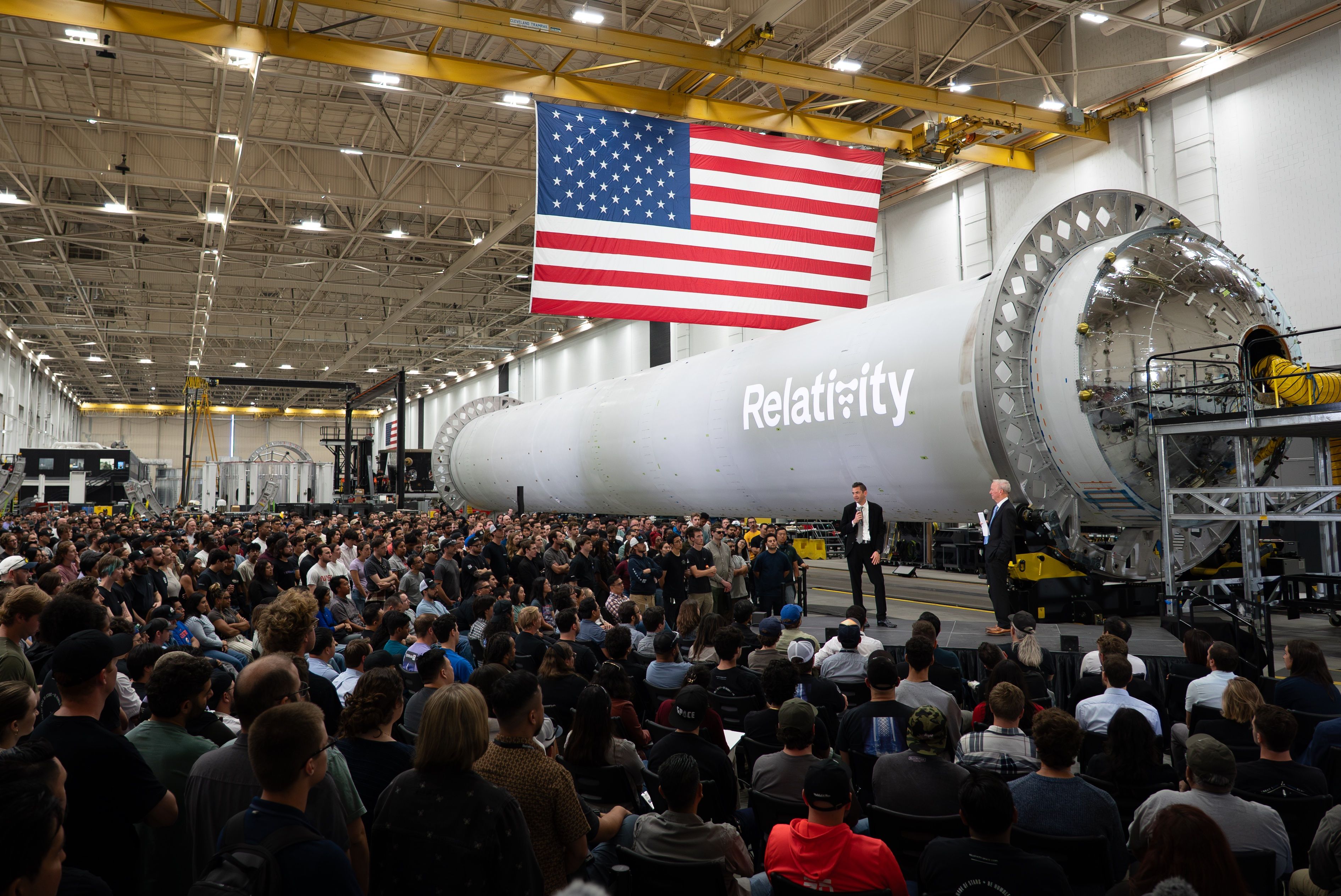
Image of NASA Administrator Jared Isaacman, onstage with Relativity Space CEO Eric Schmidt, announcing a public-private partnership to advance Mars science during an event at Relativity Space on June 17, 2026 courtesy of Relativity Space via NASA.
NASA
Specifically, Long Beach,California-based Relativity Space will supply the spacecraft, rocket, and cruise operations necessary to deliver NASA’s Aeolus instruments to Mars.
The structure of the contract is akin to the deals that NASA made with SpaceX to fly cargo to the International Space Station, or Firefly Aerospace to put a lander on the Moon — the government agency handling the science while the private company provides low-cost infrastructure, per TechCrunch.
Aeolus is scheduled to launch in 2028 and is comprised of a NASA-developed suite of four complementary instruments designed to provide the first integrated, daily, global view of Martian winds, temperatures, dust, and clouds, according to NASA.
“By improving models for dust, winds, temperature, and seasonal atmospheric behavior, Aeolus will generate the detailed environmental knowledge required to reduce risk for future crewed and uncrewed landings,” reads yesterday’s press release from NASA. “These measurements will directly inform entry, descent, and landing systems and support safer, more predictable mission planning for astronauts.”
Researchers at NASA’s Ames Research Center in California’s Silicon Valley will design, build, and integrate the payload, while Relativity Space will manage spacecraft development and mission operations, per NASA.
“Public-private partnerships like this are a force multiplier for science,” said NASA Administrator Jared Isaacman. “By pairing NASA’s world‑class instruments with commercial innovation and investment, we can deliver more science, more often, and reduce the time it takes to get essential data into the hands of researchers preparing for future human missions to Mars.”
Per NASA, the Aeolus payload suite includes the following four NASA‑built instruments:
- “Doppler Wind and Temperature Sounder (DWTS‑Ozone): Measures wind and temperature profiles from the surface up to approximately 37 miles (60 km). A collaboration with GATS.
- Thermal Limb Sounder (TLS): Provides vertical temperature profiles and observations of dust and water‑ice clouds. A collaboration with Xiomas Technologies.
- Surface Radiometric Sensor Package (SuRSeP): Measures surface energy balance, dust, and cloud properties.
- Wide‑Field Context Camera (WFCC): Captures daily global images of atmospheric activity.”
NASA will support operations of science instruments for at least one Martian year, while Relativity Space maintains the spacecraft, according to the agency.


