
Japan Has Become the Fifth Country to Land a Spacecraft on the Moon; Status of Moon Lander to be Released This Week (Updated)
JAXA's unmanned SLIM spacecraft made a soft landing on the lunar surface early on Saturday morning (JST).
(Japan) The Japan Aerospace Exploration Agency’s (JAXA) unmanned Smart Lander for Investigating Moon (SLIM) touched down on the moon’s surface at approximately 10:20am EST on Friday morning (12:20am JSP on Saturday morning), according to JAXA’s telemetry readings, making Japan the fifth country to land on the moon.
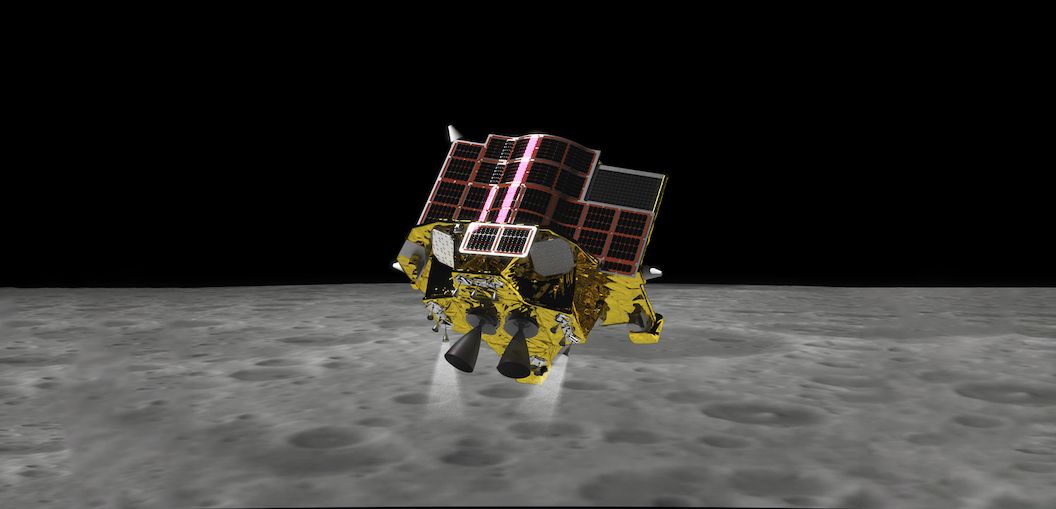
Photo of JAXA’s Smart Lander for Investigating Moon (SLIM), courtesy of JAXA: SLIM is a small-scale exploration lander designed for pinpoint landings on the Moon’s surface, reduction in the size and weight of equipment used in Moon landings, and investigations into the Moon’s origins; it will also test technology fundamental to exploration in low-gravity environments, according to JAXA.
Japan’s SLIM is a cargo research mission carrying a variety of scientific payloads, including an analysis camera and a pair of lunar rovers. Per a press release from JAXA, upon landing the SLIM probe’s solar panels were generating less electricity than planned on the lunar surface; if the problem was not rectified, SLIM could have gone forever silent, as its battery can only support operations on the moon for a few hours, according to Space.com. JAXA has not provided updates on the situation since its above-referenced January 20th release.
**updated on January 22nd: JAXA has not provided specific updates on the situation since its above-referenced release, but a post from its X account, @jaxa_en, this morning indicated that more information about SLIM’s status will be released toward the end of this week.
According to Space.com, one of JAXA’s objectives for SLIM is aimed at demonstrating that small, relatively inexpensive spacecraft are capable of impressive exploration feats. The probe weighs just 440 pounds (200 kilograms) without propellant, and the SLIM mission cost about 18 billion yen ($120 million US) to develop, according to The Planetary Society.
Japan’s ‘moon-landing’ status follows that achieved first by Russia (the Soviet Union) – which was the first country to land an unmanned spacecraft on the moon – followed by the United States (the first, and only, country to land human astronauts on the moon), China, and India. India joined the list of moon landings with its Chandrayaan-3 mission on August 23, 2023.
Governments and private companies alike have made more than 50 attempts to land on the moon with mixed success since the first attempts in the early 1960s, a track record that’s remained shaky even in the modern era., according to NBC News.
The aforementioned NBC News article points out that last year, Japanese company ispace made its first attempt to land on the moon, but the spacecraft crashed in the final moments. Earlier this month, U.S. company Astrobotic Technology got its first moon mission, Peregrine 1, off the ground but encountered problems shortly after launch; the flight was cut short and failed to make a lunar landing.
Additional attempts are planned for this year by U.S. companies Intuitive Machines and Firefly Aerospace, and China plans to launch another lunar lander in May, according to NBC News.


