
Holy, Odysseus! Lunar Lander Will ‘Go to Sleep’ After Sending Snapshots From Moon Landing
Intuitive Machines’ lunar lander, Odysseus, is almost out of time before it stops generating solar power on the moon and will be “put to sleep," in hopes that it can be woken back up in a few weeks.
(Johnson Space Center, Texas) At a press conference that began at 2pm EST today (Feb. 28th), Intuitive Machines (NASDAQ: LUNR) officials said that it was only a matter of hours before they would put their Odysseus lunar lander “to sleep” as it stops generating solar power on the moon, in hopes that it can be “woken back up” in a few weeks; ahead of the shutdown, the moon lander has sent some unbelievable images back to Earth (see below).
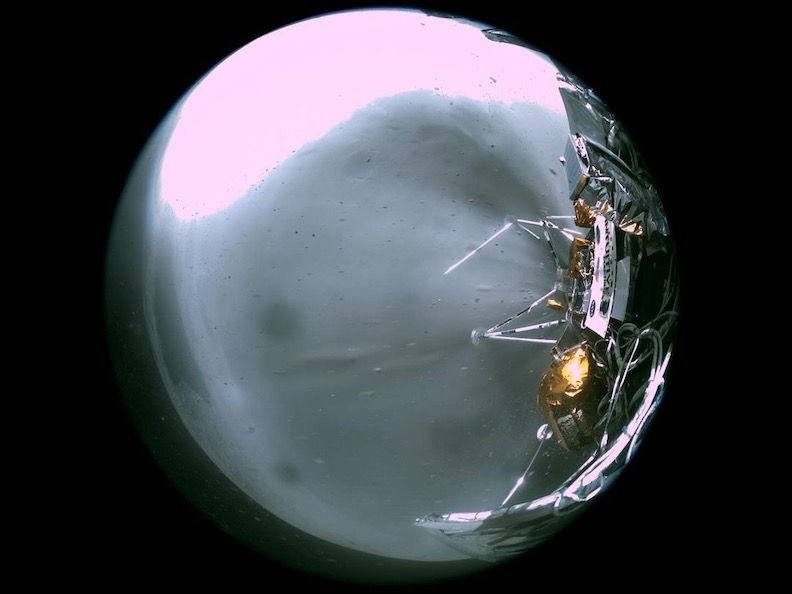
An image retrieved from the Odysseus lunar lander on February 27th that captures Odysseus’ landing leg as it performed its primary task: first contact with the lunar surface, via a post from @nasaartemis and @nasajohnson on Instagram, courtesy of Intuitive Machines.
"I think what we’re going to do is kind of tuck Odie in for the cold night of the moon and see if we can’t wake him up here when we get the solar noon here in about three weeks," once the lunar night ends, said Intuitive Machines Chief Executive Officer and co-Founder Steve Altemus during the press conference, according to CBS News.
On Thursday, February 22nd, Houston-based Intuitive Machines confirmed that its Odysseus Lunar Lander had accomplished the first moon landing by a U.S.-built spacecraft since NASA’s 1972 Apollo 17 mission, and had simultaneously become the first-ever moon-landing spacecraft to be built and launched by a private company.
A SpaceX Falcon 9 launched Intuitive’s IM-1 mission to lunar transfer orbit from Launch Complex 39A (LC-39A) at the Kennedy Space Center in Florida on February 15th.
Without illumination on Odysseus’ solar panel, the lander, which is already degrading in power, will lose energy; if all goes according to plan, Intuitive will try to ping Odysseus with an antenna and wake it back up in a few weeks, according to CBS News.
During today’s briefing at the Johnson Space Center in Texas, Intuitive Machines and the National Aeronautics and Space Administration (NASA) recapped Odysseus’s six days of operation during the lunar surface, shared photos – including those demonstrating its off-kilter configuration – and discussed the future with respect to the IM-1 mission’s next phase, according to Universe Today.
Intuitive’s original plan called for the solar-powered spacecraft to be turned off when the sun fell below the lunar horizon, but CEO Altemus said at the press conference that mission controllers would instead put the Odysseus into hibernation and try restoring contact in three weeks’ time, according to Universe Today.
“We are going to leave the computers and the power system in a place where we can wake it up and do this development test objective, to actually try to ping it with an antenna and see if we can’t wake it up once it gets power again,” Altemus told reporters.
NASA’s deputy associate administrator for exploration, Joel Kearns, said at the press conference that NASA considered the mission to be a success despite the difficulties encountered during Odysseus’ landing; he also said the mission validated NASA’s strategy of enlisting private companies to provide robotic rides to the moon, per Universe Today.
“It’s an exciting time to be on Day 6 of this new era in the 21st century,” Kearns said.
According to Sun Lederer, NASA’s project scientist for CLPS at Johnson Space Center, every one of NASA’s IM-1 payloads achieved “some level of their objectives, and we’re very excited about that.”


