
Eve Air Mobility Announces Completion of First Transition Flight
The flight marked the first time that the aircraft’s pusher propulsion system has been activated while in the air.
(Melbourne, Florida) Eve Air Mobility (NYSE: EVEX) announced today (Aug. 3) that its engineering prototype has completed its first partial transition flight, thereby enabling Eve to advance its electric vertical takeoff and landing (eVTOL) aircraft testing program toward wing-borne flight.
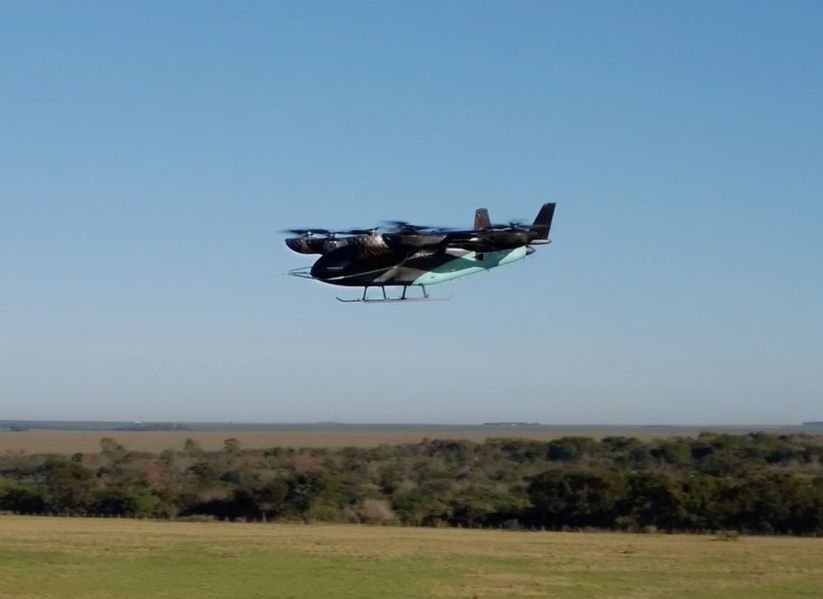
Image of Eve Air Mobility’s electric vertical takeoff and landing (eVTOL) aircraft during its recent first partial transition flight courtesy of Eve Air Mobility.
Per today’s press release from Eve, the transition flight involved the activation of the aircraft’s rear pusher propeller, thereby signifying the start of the transition phase from vertical to wing-borne flight.
The successful completion of this initial partial transition test further advances Eve’s efforts to expand the aircraft’s flight envelope and validate system performance, according to the company.
During the transition flight test, the aircraft attained a stabilized speed of 27 knots and a maximum ground speed of 30 knots whilst the pusher was activated up to 1,200 RPM. The flight took 3 minutes and 9 seconds, traveled approximately 0.84 nautical miles and attained a maximum height of 90 feet above ground level, per Eve.
“This first partial transition flight is an important milestone in Eve’s development journey,” said Johann Bordais, chief executive officer of Eve Air Mobility. “Successfully activating the pusher propulsion system in flight validates a key aspect of our aircraft design and brings us one step closer to delivering safe, efficient and scalable air mobility solutions.”
Following the aircraft’s flight-testing program, Eve plans to conduct datalink testing to validate radio link performance and support operations at speeds up to 50 knots.
In the coming weeks, Eve expects to progressively expand the aircraft’s airspeed envelope, including additional flights with pusher activation as part of the broader transition flight-test campaign, according to the company.


