Blue Origin’s New Glenn Mission, NG-1, Reaches Orbit and Delivers Blue Ring Pathfinder Payload
Blue Origin’s 270-foot tall new Glenn rocket reached its intended orbit during today’s NG-1 mission and successfully delivered its first payload.
(Cape Canaveral, Florida) Blue Origin’s 320-foot tall New Glenn mega-rocket safely reached its intended orbit during this morning’s NG-1 mission, thereby accomplishing the company’s primary objective for New Glenn’s inaugural mission; the rocket launched from Launch Complex 36 (LC-36) at Cape Canaveral Space Force Station in Florida at 2.03 a.m. ET (0700 GMT) this morning.

Photo of Blue Origin’s New Glenn rocket launching to orbit courtesy of Blue Origin CEO Dave Limp on X, @davill.
New Glenn was successful in delivering its payload, the Blue Ring Pathfinder, which Blue Origin said is receiving data. The Pathfinder is being used to test technology created for a transfer vehicle designed to deliver satellites to their planned orbits that can carry 3,000 kilograms of payload, according to Quartz.com.
New Glenn’s booster did not accomplish its intended landing on a ship in the Atlantic Ocean, nicknamed Jacklyn, after Blue Origin Founder Jeff Bezos’ mother; the booster fired up three of its engines in a reentry burn as planned, but did not stick the landing, according to Space.com.
Ahead of launch, Blue Origin stressed repeatedly that an intended booster landing was a secondary goal that was unlikely to be achieved on NG-1.
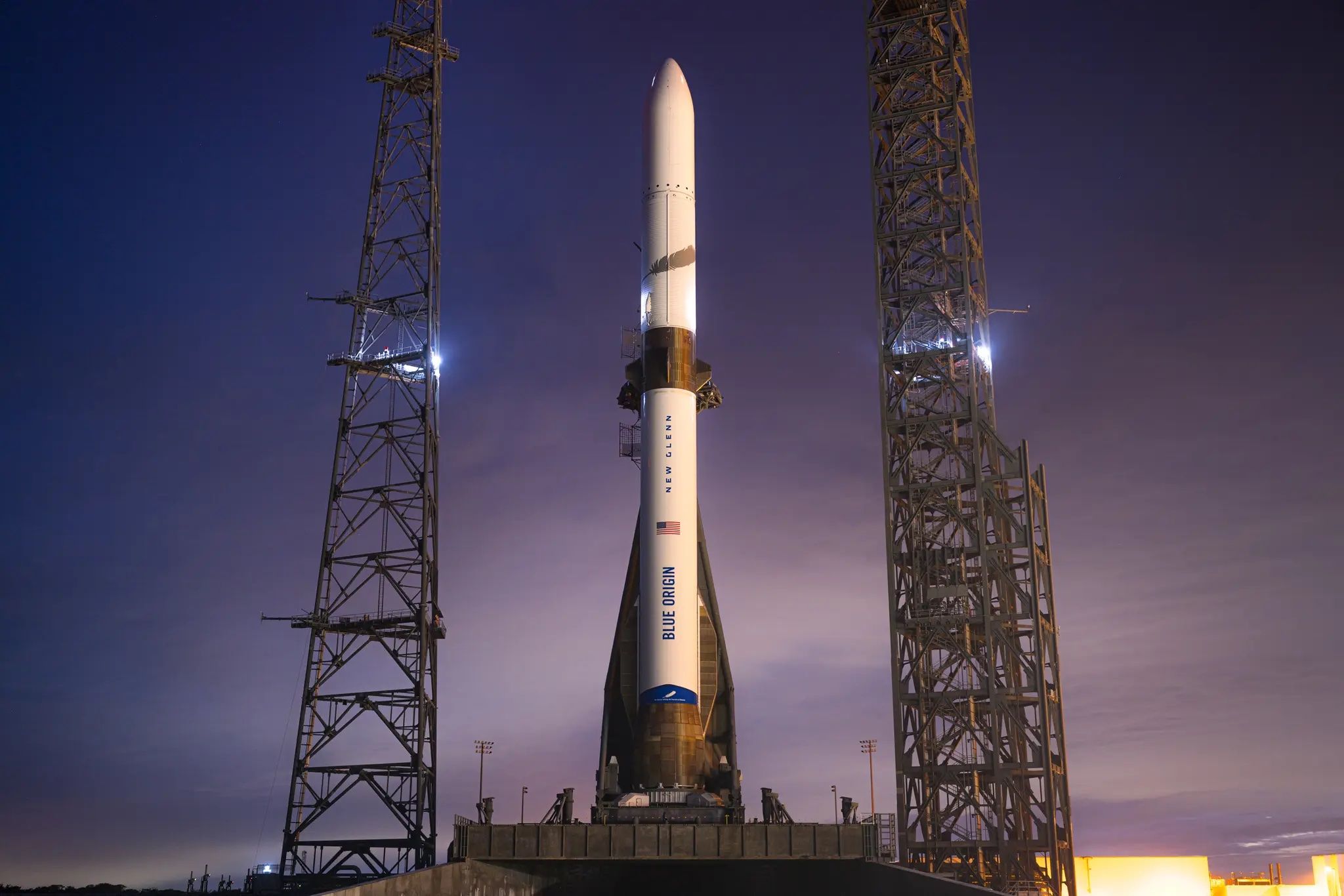
Photo of Blue Origin’s New Glenn rocket on its launch pad, LC-36, in Cape Canaveral, Florida, courtesy of Blue Origin.
"We got to orbit safely,” Ariane Cornell, vice president of in-space systems at Blue Origin, said in the company’s launch webcast. "Congratulations, everybody. What a day!"
New Glenn’s first flight was initially projected to take place in 2020, but its timeline was slowed by the development of the rocket’s powerful BE-4 first-stage engines, according to Space.com.
Post-liftoff, New Glenn’s first stage is intended to autonomously descend to a landing platform located 620 miles (1,000 km) downrange; two BE-3U then engines ignite, propelling the rocket’s second stage into space; and once the fairing separates, the rocket’s payloads are delivered into orbit, according to Blue Origin’s website.
According to Blue Orgin’s website, New Glenn’s first stage booster, which is designed for a minimum of 25 flights, operates “like a commercial airliner (but with cleaner fuel)” and will therefore lead to significantly less waste and cost vs. traditional rockets.
The rocket’s reusable first stage could help it to compete with SpaceX’s Falcon 9, the world’s first orbital-class reusable rocket.
Per Blue Origin, the rocket’s seven-meter fairing designed to accommodate a variety of payloads and destinations in order to meet a broad range of customer needs and significantly reduce cost per launch vs. traditional vehicles.
“With twice the volume of smaller, five-meter class payload fairings, customers have more flexibility to package their payload in new ways,” reads an explanation on Blue Origin’s website.
“Twice the volume of traditional five-meter class fairings means room for bigger constellations and larger payloads,” the website explains.
According to an Instagram post from AST SpaceMobile, @astspacemobile, New Glenn maintains the capacity to carry eight of its BlueBird satellites in a single launch, and provides “one more road to space” for the company’s next-generation Block 2 Bluebird satellites – each of which measures 24,000 sq. feet in diameter – and which AST intends to comprise the largest-ever commercial communications array in LEO.

Infographic of New Glenn’s payload capacity in relation to AST SpaceMobile’s next-gen Block-2 Bluebird satellites courtesy of AST SpaceMobile on Instagram,@astspacemobile.
“We are paving the way for space-based cellular broadband for every corner of the globe,” reads AST Spacemobile’s Instagram post.
New Glenn’s liquid hydrogen-powered upper stage can carry more than 13 metric tons to geostationary transfer orbit (GTO) and 45 metric tons to low Earth orbit (LEO), according to Blue Origin.
Blue Origin’s current list of partners includes Amazon, NASA and AST Spacemobile.
- Amazon: Amazon’s Project Kuiper will fly advanced satellites to deliver high-speed, low-latency broadband service globally.
- NASA: ESCAPADE is a dual spacecraft mission to study solar wind energy on Mars.
- AST SpaceMobile: AST SpaceMobile is building the first and only space-based cellular broadband network designed for both commercial and government applications.