Blue Origin Completes 29th New Shepard Flight, Simulates Lunar Gravity
Today’s (Feb. 4) flight from Launch Site One in Texas marked Blue Origin’s 14th payload.
(Van Horn, Texas) Jeff Bezos’s Blue Origin launched its 29th New Shepard flight and 14th payload mission today from Launch Site One in West Texas at 11am EST (1600 GMT); the payloads experienced about two minutes of lunar gravity forces.
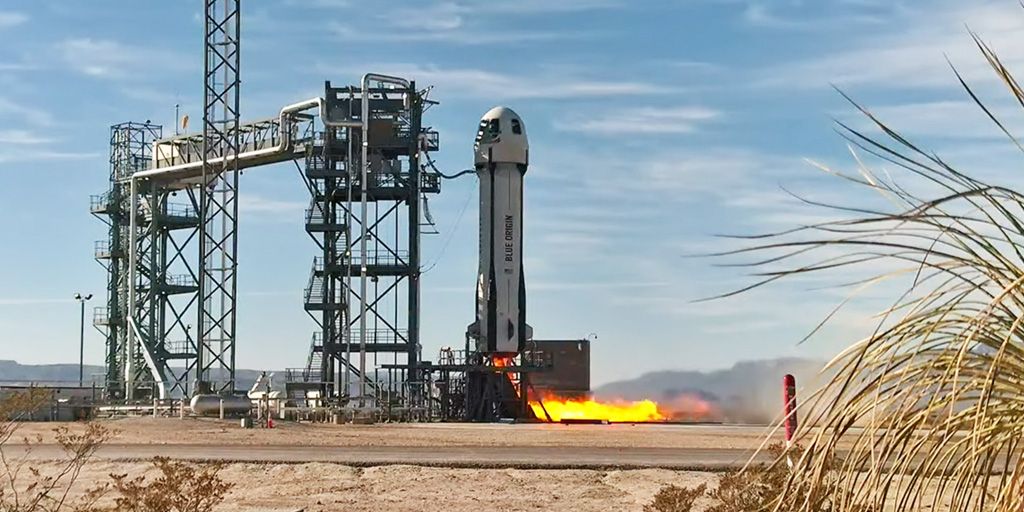
Photo of Blue Origin’s New Shepard rocket about to lift off on its NS-29 mission courtesy of Blue Origin on X, @blueorigin.
The capsule created “lunar gravity forces” – a first for a New Shepard mission – during the flight by firing its reaction-control thrusters in order to rotate about 11 times per minute for roughly two minutes, simulating one-sixth Earth gravity at the midpoint of the crew capsule lockers, according to today’s mission statement from Blue Origin
The twist was conducted to serve the mission’s 30 research payloads from NASA, 29 of which tested lunar-related technologies, per Space.com. The technologies can be grouped into six main categories, per Blue Origin (via Space.com): "in-situ resource utilization, dust mitigation, advanced habitation systems, sensors and instrumentation, small spacecraft technologies, and entry, descent and landing."
Per Space.com, more than half of NS-29’s payloads were supported by NASA’s Flight Opportunities Program – data about the lunar environment is important to the space agency, which is working to establish a permanent human presence on and around the moon via its Artemis program.
"We are excited to bring our lunar-G capability online. Thanks to NASA for the support. This is an entirely new way to bring lunar gravity to NASA and other lunar technology providers, accelerating their research and tech readiness at a much lower cost. Plus, we can adapt this New Shepard capability to closely mirror Mars and other solar system gravity environments in the future," said Blue Origin CEO Dave Limp said in an X post on Jan. 24.

Photo of Blue Origin’s New Shepard rocket in flight mission courtesy of Blue Origin.
Two specific NASA experiments aboard New Shepard today included the Electrostatic Dust Lofting project, which investigated how moon dust gets electrically charged and lifted up when exposed to ultraviolet light, and the Lunar-g Combustion Investigation, which studied how materials catch fire in the moon’s gravity compared to Earth’s, according to Space.com.
"The findings will help NASA and its partners create safer living and working habitats for people on the moon,” reads an excerpt from Blue Origin’s mission statement.
“New Shepard’s ability to provide a lunar gravity environment is an extremely unique and valuable capability as researchers set their sights on a return to the Moon,” said Phil Joyce, SVP, New Shepard. “This enables researchers to test lunar technologies at a fraction of the cost, rapidly iterate, and test again in a significantly compressed timeframe.”