Blue Origin and Cerberus Offer Competing Bids in United Launch Alliance (ULA) Buyout
ULA - which was, prior to SpaceX, the United States’ dominant rocket-launch company - has received buyout bids from both Bezos’s space startup and the private equity giant.
(Denver, Colorado) United Launch Alliance – which has been owned equally by Boeing (NYSE: BA) and Lockheed Martin (NYSE: LMT) since the company’s formation in 2006 – has received buyout bids from Jeff Bezos’s space company, Blue Origin, and Cerberus, Stephen Feinberg’s private-equity giant.
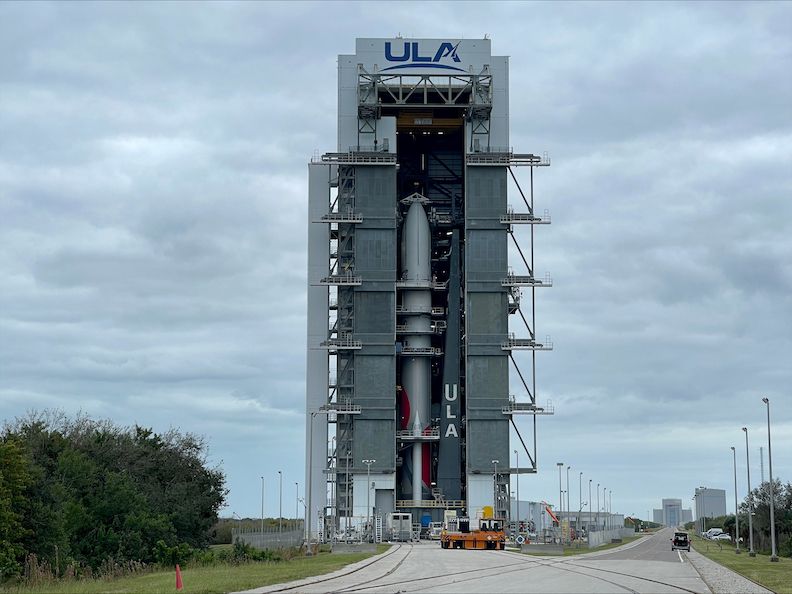
Photo courtesy of United Launch Alliance (uploaded December 20, 2023): United Launch Alliance (ULA) hoists the Certification-1 (Cert-1) payloads atop the Vulcan rocket in the Vertical Integration Facility (VIF) adjacent to Space Launch Complex-41 at Cape Canaveral Space Force Station. The mission will launch the first Astrobotic Peregrine commercial lunar lander, as part of NASA’s Commercial Lunar Payload Services (CLPS) initiative, into a highly elliptical orbit more than 220,000 miles (360,000 km) above Earth to intercept the Moon and carry a Celestis Memorial Spaceflight Payload into deep space.
The amounts associated with Blue Origin’s and Cerberus’s bids have not been disclosed. Blue Origin has an existing relationship with ULA to supply its LNG-fueledBE-4 rocket engines to ULA’s Delta IV and Atlas V rockets.
Aviation and defense manufacturer Textron Inc. (NYSE: TXT) has also allegedly expressed interest in purchasing ULA, according to The Wall Street Journal.
It is believed that ULA has effectively been up for sale for much of the year, according to Benzinga. Ars Technica reported in November that its joint owners were close to selecting a buyer from three unnamed bidders.
The WSJ noted that “some people familiar with the potential sale have said valuing ULA could be challenging in part because its historical performance is based on rockets it is discontinuing. “ That said, Jefferies has estimated that ULA would fetch $2 billion to $3 billion in a sale, according to the Journal, and previously, in 2015, Aerojet Rocketdyne Holdings – at that time, a major supplier of engines for many ULA rockets – bid about $2 billion for the company.
In 2006, regulators approved the formation of ULA as an equal joint venture by Boeing and Lockheed Martin, ending years of rocket-launch rivalry between the two companies. According to the WSJ, Pentagon officials at that time supported the creation of ULA to ensure the combined company would continue to make Boeing’s Delta IV and Lockheed’s Atlas V vehicle families available to launch defense and intelligence satellites.
Since inception, ULA has completed more than 155 missions. Boeing and Lockheed are allegedly now seeking to sell ULA as it phases out the Delta and Atlas vehicles and moves to replace them with a new Vulcan Centaur rocket; the Vulcan’s inaugural launch is currently planned for January 8, 2024.
According to the WSJ, Tory Bruno, ULA’s chief executive, recently told reporters that the company had sold 70 Vulcan flights to date, giving ULA a backlog worth billions of dollars.